Skip to content



When it comes to LED screens for events and stages, rental applications require more than just good image quality. A rental LED display needs to be easy to install, convenient to maintain, reliable through repeated use, and cost-effective over its service life.
As an LED display manufacturer, we offer a wide range of rental LED display solutions for different project requirements, like series R, RA, RH, etc. In this article, we’ll take Rental Series RH and Rental Series RA as two specific examples to explore how different product designs can meet different rental application needs.
Both solutions are designed for events, stages, and other rental applications, with the P3.91mm 500 × 1000 mm LED cabinet used as an example. While their core display specifications can be similar, they feature different internal designs and configurations. These differences can affect the cabinet’s maintenance experience, reliability considerations, deployment efficiency, and overall cost.
So, what makes Series RH and Series RA different—and which rental LED solution is right for your project? Let’s take a look.
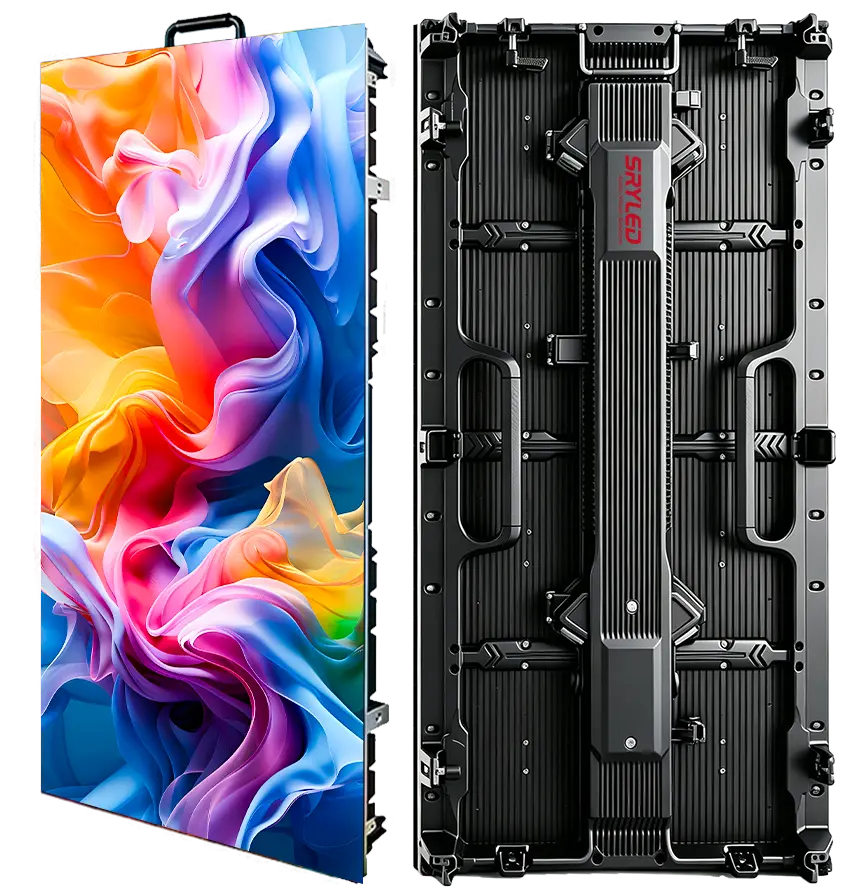
500X1000mm Rental Series RH
Two LED Solutions for Different Project Requirements
RH and RA are both designed for rental LED display applications, but they feature different cabinet designs to address different project requirements.
At first glance, the two solutions may appear quite similar. Both can use a P3.91mm 500 × 1000 mm LED cabinet, and their core display specifications can be comparable. However, their internal designs and configurations are different, giving each solution its own characteristics in terms of maintenance, deployment, and cost.
Rental Series RH
RH features a cabinet design that places greater emphasis on maintenance convenience and efficient servicing.
Its internal connection uses a HUB-based design between the component and LED modules. By organizing the module connections through a HUB, the cabinet can have a cleaner internal structure with fewer individual cable connections.
This design can be particularly suitable for projects involving frequent installation and dismantling, repeated transportation, or long-term rental operation, where maintenance efficiency is an important consideration.
Rental Series RA
RA uses a different internal connection approach, with components connected to the LED modules through cables.
This design provides a straightforward connection structure and can offer advantages for projects where overall project budget and specific application requirements are important considerations.
It can be a suitable choice for rental projects with different deployment frequencies, operating conditions, and budget expectations.
Two Solutions for Different Project Needs
The difference between RH and RA should not be understood simply as one being better or more advanced than the other.
Instead, they are two product solutions designed to meet different project requirements and budget considerations.
The right choice depends on factors such as:
- How frequently the cabinets will be installed and dismantled
- How often maintenance or module replacement may be required
- How the displays will be transported and deployed
- The expected duration and frequency of rental operation
- The project’s overall budget and cost expectations
The different internal connection designs are one of the factors that contribute to these differences.
In the following sections, we will take a closer look at the internal architecture of Rental Series RH and Rental Series RA and explain how the HUB-based and cable-based designs can affect the maintenance and deployment experience.
The Key Difference: HUB-Based vs. Cable-Based Connection
One of the main differences between series RH and series RA is how the LED modules are connected inside the cabinet.
Although this may seem like a relatively small technical detail, the connection architecture can have a direct impact on the cabinet’s internal structure, maintenance process, and troubleshooting experience.
Series RH
The HUB board acts as a centralized connection interface. Signal and power are distributed to the LED modules through the interfaces on the HUB board.
This creates a more organized, modular internal structure. Instead of relying on multiple individual cables to connect the receiving card, power supply, LED modules and so on, the connections are concentrated through the HUB.
This approach can provide several practical benefits:
- Fewer individual internal cables
- More organized cabinet structure
- More direct module connections
- Easier access to internal components
- More convenient module replacement and maintenance
- Potentially more efficient troubleshooting
Also in some HUB-based cabinet designs(like our Rental series R), the rear cover or relevant assembly can also be removed as a complete unit, giving technicians easier access to the modules and internal components during maintenance.
Series RA
Rental Series RA uses a cable-based connection design:
In this architecture, the connection of components—such as signals and power, receiving card—between the LED module relies on various cables and connectors.
This is also a commonly used approach for LED cabinets and can provide a practical solution for different rental applications.
However, compared with a centralized HUB architecture, a cable-connected cabinet contains more individual cables, connectors, and connection points.
As a result, when a display problem occurs, technicians may need to inspect individual connections to identify the cause.
This does not mean that a cable-based cabinet is inherently unreliable. Rather, the greater number of individual connections can make the troubleshooting process more dependent on checking cables and connectors one by one.
From an engineering perspective, the main advantage of a HUB-based design is connection integration.
By concentrating signal and power distribution on the HUB board, the cabinet can reduce the number of individual internal cable connections and create a more modular structure.
This can be particularly valuable in rental applications, where cabinets may be repeatedly installed, dismantled, transported, and maintained.
For example, when a module needs to be replaced, a more organized connection structure can make it easier for technicians to identify the relevant connection and complete the replacement efficiently.
What About Reliability?
Connection architecture is one factor in LED cabinet reliability, but it is not the only one.
Cable quality, connector quality, component selection, cabinet design, thermal management, assembly quality, transportation, installation, and maintenance practices can all affect long-term performance.
Therefore, rather than saying that a HUB-based design will not fail or that a cable-based design is unreliable, it is more accurate to say:
By reducing individual cable and connector connections, a HUB-based architecture can simplify the cabinet’s internal structure and reduce potential cable- and connector-related maintenance points.
This distinction is particularly relevant when a rental LED display is used frequently or needs to be serviced under tight event schedules.
In the next section, we will look more closely at how these different connection architectures can affect maintenance efficiency and reliability in real rental applications.
Maintenance and Reliability in Real Rental Applications
For a rental LED display, the cabinet does not simply operate in one fixed location for years. It may be transported from one venue to another, installed and dismantled repeatedly, and serviced under tight schedules.
This makes maintenance efficiency and connection reliability important considerations when selecting a rental LED solution.
Frequent Installation and Dismantling
Rental LED cabinets may be handled many times throughout their service life.
Every installation and dismantling operation involves physical handling of the cabinet, module connections, power connections, and signal connections. Over time, individual cables and connectors can become additional points that technicians need to inspect.
With its HUB-based architecture, series RH reduces the number of individual internal cable connections. This creates a more organized internal structure and can make routine module replacement and maintenance more straightforward.
Series RA uses individual cables for module connections. This design remains practical for rental applications, but when a connection-related issue occurs, technicians may need to check the relevant cables and connectors individually.
For rental companies managing a large inventory of cabinets, even small differences in maintenance procedures can become meaningful when multiplied across many deployments.
Outdoor and High-Temperature Applications
Outdoor rental LED displays may operate in challenging environments, including high temperatures, humidity, dust, vibration, and frequent transportation.
In these conditions, every component and connection needs to be designed and maintained appropriately.
Cable and connector quality are particularly important because repeated mechanical handling, improper installation, or environmental exposure can affect connection performance over time.
A HUB-based architecture can reduce the number of individual cable connections inside the cabinet, which means there are fewer cable- and connector-related points that require inspection.
However, this should not be interpreted as meaning that a HUB-based cabinet is automatically more reliable in every environment. Overall reliability depends on the complete cabinet design, including:
- LED modules
- Receiving card
- HUB board
- Power supply
- Cables and connectors
- Cabinet structure
- Thermal management
- Waterproofing
- Assembly quality
- Installation and maintenance practices
This is why the choice between Series RH and Series RA should be based not only on the initial purchase price, but also on how the equipment will be used throughout its service life.
Different Priorities, Different Solutions
Series RH and RA therefore represent different approaches to the same rental application.
RH can be a strong choice when frequent deployment, maintenance efficiency, and a more organized internal connection structure are important priorities.
And RA can be suitable when the project’s operating requirements and budget make a cable-based connection architecture a practical choice.
Neither solution is universally better. The key is to match the cabinet design with the project’s actual operating conditions.
Which LED Screen Should You Choose?
After looking at the cabinet structure, connection architecture, maintenance considerations, and control-system configuration, we can now return to the most important question: which solution is right for your project?
There is no universal answer. Series RH and Series RA are designed to meet different project requirements, so the best choice depends on how the LED display will be used and what your project needs to prioritize.
Rental Series RH can be a better fit when your project involves:
- Frequent installation and dismantling
- Repeated transportation between venues
- Long-term or frequent rental operation
- A strong focus on maintenance efficiency
- A preference for a more organized internal cabinet structure
- A need to simplify cable- and connector-related troubleshooting
The HUB-based architecture can help reduce individual internal cable connections and make the cabinet’s connection structure more centralized.
For rental companies managing equipment across many events, these characteristics can make maintenance more convenient over the product’s service life.
Choose Rental Series RA When Project Budget and Application Requirements Call for a Different Approach
Rental Series RA may be a suitable choice when:
- The project has a specific overall budget
- The display will be used less frequently
- The expected rental period is relatively short
- A cable-based connection architecture meets the project’s requirements
You should looking for a practical solution without prioritizing a HUB-based internal structure.
This does not mean that Series B is a “basic” or “lower-level” product.
Rather, its cable-based architecture represents a different product approach for different project requirements and budget considerations.
Consider Total Cost, Not Only Initial Price
For rental LED displays, the purchase price is only one part of the overall cost.
If a display is installed and dismantled frequently, maintenance labor, troubleshooting time, spare parts, transportation, and equipment downtime can also contribute to the total cost of ownership.
On the other hand, if the display is used only occasionally, the benefits of a more maintenance-oriented architecture may not justify a higher initial investment for every project.
This is why the right comparison is not simply:
“Which cabinet costs less?”
A better question is:
“Which solution provides the right balance between performance, maintenance, deployment requirements, and budget for this project?”
The Right Solution Depends on the Project
SeriesRH and RA are two different solutions both for rental LED display applications.
RH is well suited to projects that place greater emphasis on frequent deployment, maintenance efficiency, and a more organized internal connection structure.
While RA can be a practical choice for projects with different operating patterns and budget considerations where a cable-based connection architecture meets the application requirements.
Ultimately, neither solution is universally better. The right choice is the one that best matches your project’s operating conditions, maintenance expectations, deployment frequency, and budget.
Conclusion: Choose the Rental LED Solution That Fits Your Project
Both solutions can serve events, stages, and rental applications, while their different cabinet architectures are designed to address different project requirements.
The HUB-based design of Series RH provides a more centralized and organized internal connection structure, which can be particularly valuable for projects that involve frequent installation, dismantling, transportation, and maintenance.
The cable-based design of Series RA provides a different approach that can meet the requirements of projects with different operating conditions and budget considerations.
When comparing the two, it is therefore important to look beyond the question of HUB vs. Cable. Instead, consider the complete project:
- How frequently will the LED cabinets be installed and dismantled?
- How long will the equipment be in rental operation?
- How important is maintenance efficiency?
- What environmental and operating conditions will the display face?
- What control-system configuration does the project require?
- What is the overall project budget?
- What balance between initial investment and long-term operating requirements makes sense?
There is no single solution that is right for every rental application.
Rental Series RH and Rental Series RA are two different product solutions for different project needs and budget considerations. The best choice is the one that matches the way your LED display will actually be deployed, maintained, and operated.
If you are comparing rental LED display solutions for an upcoming project, our team can help you evaluate the cabinet configuration, control system, maintenance requirements, and overall project needs to identify the most suitable solution.